

Material grade is one of the first questions in a stainless steel sink specification, but the correct answer depends on the service environment and commercial goal. Type 304 is widely used for residential and commercial kitchen equipment, while Type 316 contains molybdenum and is selected when additional resistance to localized corrosion is required. That does not mean every project should automatically move to 316.
For importers and project buyers, material selection should balance exposure, fabrication, finish, availability, lifecycle expectations, and price. It should also be supported by documentation that identifies the material used in the ordered model.
What do 304 and 316 mean?
Both 304 and 316 belong to the austenitic stainless steel family. Their chromium content supports formation of a passive surface film that provides corrosion resistance. Type 316 is additionally alloyed with molybdenum. According to stainless steel producer Outokumpu, adding molybdenum can improve resistance to localized corrosion such as pitting and crevice corrosion, particularly in more aggressive environments.
Grade names are only one part of a complete specification. Thickness, forming, welding, heat effects, surface contamination, polishing, cleaning, and long-term exposure can all influence the finished product. A correctly made 304 sink may be a better choice than a poorly controlled product sold under a higher grade name.
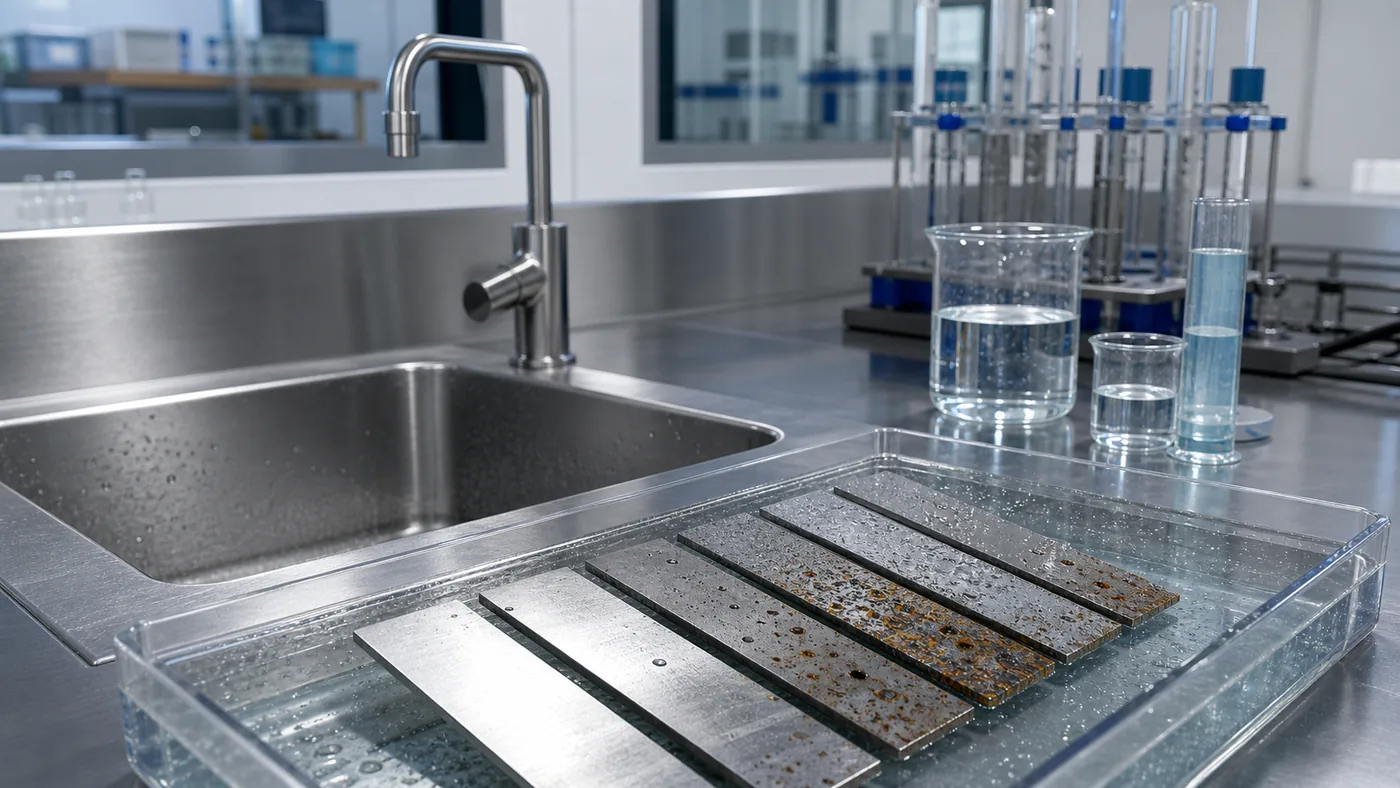
When 304 is usually appropriate
Type 304 is commonly specified for indoor kitchen sinks in residential, hospitality, and light-commercial environments. It offers a strong combination of corrosion resistance, formability, weldability, surface appearance, and availability. For standard indoor use with routine cleaning and without prolonged exposure to aggressive chlorides, 304 is often the practical choice.
Buyers should still define the cleaning environment. Chloride-containing cleaners, salt deposits, metal contamination from tools, and standing chemical residues can damage the passive surface of stainless steel. Care instructions and finish selection should match the end user’s likely maintenance conditions.
When 316 deserves consideration
Type 316 may be justified in coastal locations, marine-related applications, laboratories, food-processing environments, or projects where chloride exposure is more demanding. It may also be specified by a consultant, brand standard, tender document, or local requirement. The added corrosion resistance can support a longer service life under suitable conditions, but it comes with a higher material cost and may have different availability.
Do not select 316 solely as a marketing label. Define the actual risk: airborne salt, cleaning chemicals, process residues, temperature, wet-dry cycling, crevices, and maintenance frequency. In very aggressive conditions, even 316 may require additional material engineering and careful design.
How buyers can verify the material
Start by placing the grade in the approved drawing, quotation, purchase order, and inspection criteria. Ask for the mill material certificate or supplier documentation linked to the relevant batch when traceability is required. Portable material identification methods can support verification, but buyers should agree on the method and acceptance process before production.
A magnet test is not a reliable standalone method for distinguishing 304 from 316. Austenitic stainless steel can show some magnetic response after cold working, and magnetism does not confirm chemical composition. Chemical analysis or appropriate material identification is more meaningful when grade verification is critical.
Specify the finished sink, not only the alloy
A complete buying specification should include grade, nominal thickness and tolerance, bowl dimensions, corner radius, drain opening, mounting method, weld and surface requirements, finish direction, underside treatment, accessories, packaging, and inspection criteria. For colored finishes, confirm the coating system and care instructions separately from the base alloy.
The most economical choice is the grade that meets the real environment with an appropriate safety margin. For standard indoor kitchens, 304 is frequently suitable. For higher chloride exposure or project-specific requirements, 316 may be worth the added cost. Review Outokumpu’s guidance on stainless steel corrosion resistance and confirm the final choice against the project specification.
View our sink product range or send us your target market, application, grade, dimensions, and quantity for a project discussion.
Finish, fabrication, and care remain part of the decision
The same stainless grade can produce different results after forming, welding, grinding, and polishing. Tight corners, weld heat tint, embedded iron particles, inconsistent brushing, or poorly cleaned residues can create weak points or visible defects. Buyers should approve a finish sample under consistent lighting and define which surfaces are cosmetic. Fabrication procedures and post-fabrication cleaning therefore deserve attention alongside the alloy name.
Care instructions should reflect the market. Recommend routine cleaning with suitable non-abrasive products, rinsing, and drying where water deposits are common. Warn users against prolonged contact with aggressive chloride cleaners, steel wool, or contaminated tools. For coastal or demanding projects, discuss water chemistry, cleaning chemicals, ventilation, and maintenance frequency with the project team. If the environment is uncertain, material coupons, sample testing, or advice from a qualified materials specialist can be more useful than choosing a grade from a general comparison table.