

OEM and ODM kitchen sink projects succeed when product decisions are converted into controlled drawings, samples, production instructions, and inspection records. The process is more than adding a logo to an existing sink. Dimensions, mounting compatibility, finish, accessories, packaging, target-market requirements, and order volume all affect the final solution.
Understanding each stage helps importers and private-label brands provide better information, compare quotations accurately, and prevent late changes that affect tooling, lead time, and cost.
Stage 1: Requirement and market review
The project begins with the intended market and use case. The buyer should provide the product type, installation method, cabinet size, overall dimensions, bowl depth, drain position, material, finish, accessories, quantity, price position, packaging method, and delivery destination. Reference samples and sketches are useful, but measurable requirements are needed before a factory can confirm feasibility.
This is also the time to identify destination-market standards, labeling, language, barcode, documentation, and certification expectations. The exact model and scope should be checked; a general factory certificate does not automatically cover every product configuration.
Stage 2: Product route and quotation
The supplier evaluates whether the requirement can be met with an existing model, a modified platform, or a new custom design. Using an existing structure can reduce tooling cost and development time. A modified model may change dimensions, holes, finish, accessories, or packaging. A fully custom sink may require new tooling, fixtures, gauges, and a longer validation process.
A useful quotation separates product, tooling or development, accessories, branding, packaging, testing, and logistics assumptions. It should state the minimum order quantity, sample charge, sample lead time, production lead time, payment terms, quotation validity, and Incoterm.
Stage 3: Drawing and sample confirmation
The approved drawing becomes the technical reference. It should identify material, thickness, critical dimensions and tolerances, corner radii, drain and faucet holes, mounting details, finish, sound-control components, logo, and included accessories. Revision numbers and approval dates help prevent an outdated file from reaching production.
A physical sample confirms appearance and assembly. Buyers should install the sample when possible, not only inspect it on a table. Check countertop and cabinet compatibility, drainage, clips, seals, accessory fit, surface consistency, logo location, and carton protection. Record approved deviations instead of relying on memory.
Stage 4: Pre-production control
Before mass production, the factory converts the approved sample into material, process, inspection, and packing instructions. Incoming material is identified, tooling and fixtures are prepared, visual standards are confirmed, and packaging components are checked. For a new finish or logo, a pre-production confirmation can prevent a full batch from being produced with the wrong appearance.
Change control is essential. If a buyer changes dimensions, finish, accessories, or packing after approval, the effect on inventory, tooling, lead time, and price should be reviewed and documented before implementation.
Stage 5: Mass production and inspection
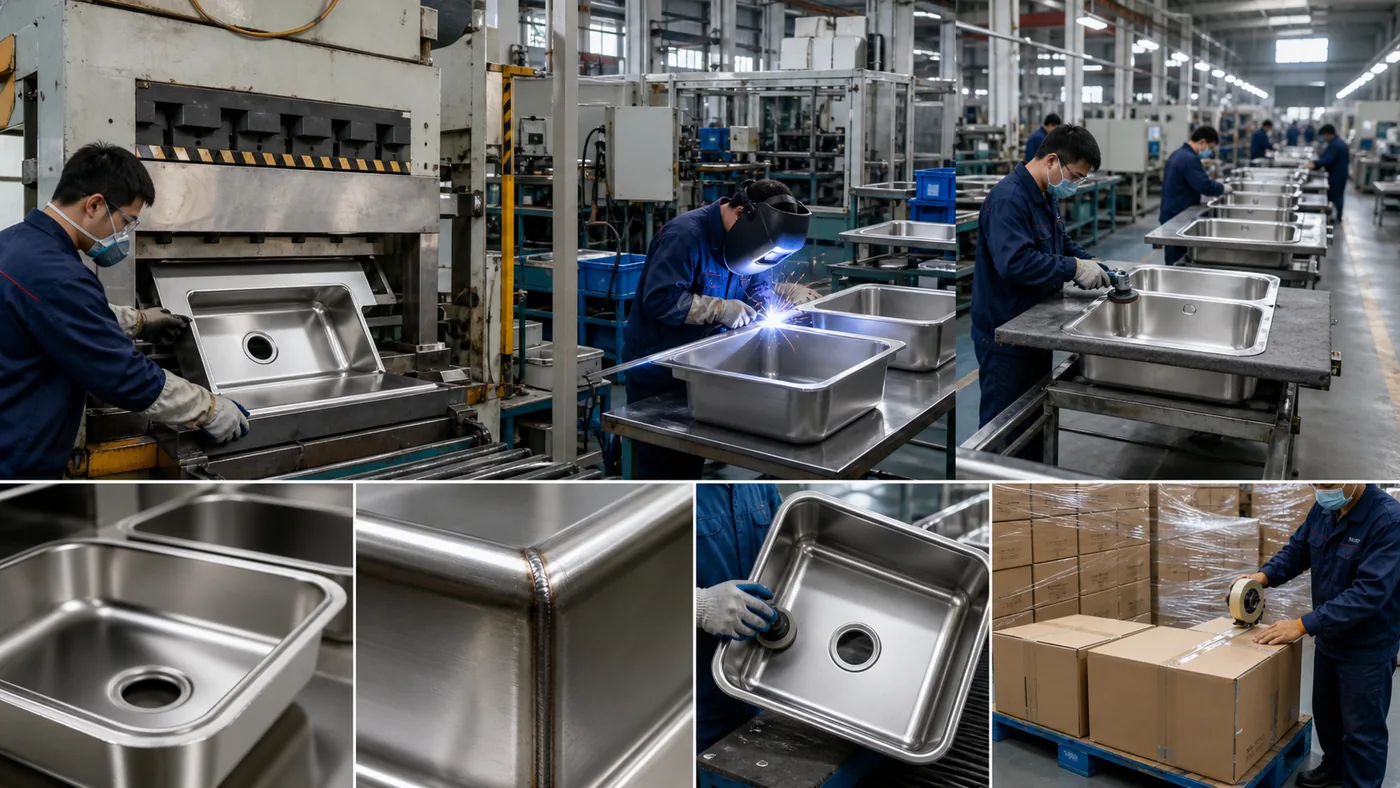
Depending on the model, production may include cutting, forming, welding, grinding, polishing, drilling, coating, underside treatment, accessory assembly, cleaning, and packing. In-process inspection catches problems earlier than final inspection alone. Critical dimensions, weld quality, flatness, drainage, surface finish, holes, accessories, and branding should be checked at agreed stages.
Final inspection should use the approved drawing and sample. The buyer and supplier should agree on sampling, defect classification, rework rules, inspection timing, and release authority. Photographs are useful, but dimensional records and clear results provide stronger evidence.
Stage 6: Branding, packing, and shipment
Private-label details can include laser marking, labels, color boxes, manuals, warranty cards, barcodes, and pallet marks. Confirm final artwork, print colors, placement, language, and scannability before mass printing. Packaging must protect rims, corners, finish, accessories, and drain components through the intended distribution route.
Before shipment, review quantities, carton dimensions, net and gross weights, pallet plan, shipping marks, inspection status, and documents. Retaining an approved sample and production records makes repeat orders more consistent.
A controlled process supports repeat orders
The purpose of an OEM or ODM process is not paperwork for its own sake. It creates a shared reference so that design intent can be repeated at production scale. Buyers who provide a complete brief and approve drawings, samples, quality criteria, and packaging early usually experience fewer surprises and faster replenishment.
Browse our sink and faucet products, then send your drawing, reference sample, target market, quantity, and packaging plan to begin an OEM or ODM discussion.
Prepare for the pilot order and future replenishment
A pilot order should be large enough to test the real production and packing process, not only the sample room. Review dimensional consistency, finish variation, accessory counts, carton performance, barcode scanning, loading, arrival condition, and installer feedback. Record corrective actions and update the drawing or specification before the first full commercial order.
For repeat business, agree on how approved materials, component suppliers, finish references, tooling, packaging artwork, and retained samples will be controlled. Ask how the factory communicates a proposed material or component change. Forecast information can help reserve capacity and long-lead components, while a clear spare-parts plan supports after-sales service. These controls turn a successful development project into a repeatable supply program rather than requiring the product to be rediscovered on every order.